At a glance
Twelve training weeks and selected Sydney laps frame the missed sub-four goal. The Prediction Lab tests conversion assumptions and the training history the formula leaves out.
I started running in late 2024 with the goal of finishing a half marathon. Less than two years later, I was preparing for Sydney.
I went into Sydney Marathon with a 1:50:57 half marathon behind me and a sub-four goal. I missed that goal. Looking back, I wanted to understand how my preparation and race execution needed to improve.
My main lessons were about consistent training, keeping marathon-specific work controlled and practising the full race-day plan. This is a review of those choices and what I want to do differently next time.
For course-specific guidance alongside this personal account, see the Sydney Marathon 2026 pacing strategy.
My intention versus the race I ran
I completed Sydney on 30 August 2026. The distinction between what I hoped to do and what I can document matters when reviewing the result.
On a small screen, swipe the table if needed.
| Before the race | What happened | What that does not establish |
|---|---|---|
| A sub-four goal, following a 1:50:57 half marathon | I did not achieve sub-four. | The half-marathon conversion was a scenario, not proof of readiness over the full distance. |
| Sustaining the run through the later kilometres | It felt difficult before 30 km; I first walked around 31–32 km. | A precise cause cannot be diagnosed from the slowdown alone. |
| Winners gels roughly every 20 minutes | Taking more became unappealing around the time I faded. | The intended schedule is not a complete record of carbohydrate or fluid consumed. |
I am not reconstructing an exact opening pace or halfway plan from workout labels or an earlier draft schedule. The sections below use recorded training and selected watch splits alongside my recollections, with interpretation kept separate.
The part of the race I need to improve
The later kilometres became a cycle of running and walking. I had the speed for a strong half marathon, but I did not maintain the effort I wanted over the full marathon.
My practical change: put more weight on repeatable long-run effort and recovery when choosing a target. The pace calculator can give me checkpoints; my training has to support the plan.
What my half marathon predicted—and what happened
My shorter-race result supported considering sub-four. I did not achieve it at Sydney. This investigation examines the assumptions behind that target and the preparation a time-only conversion cannot assess.
Prediction Lab / a model-input audit
How much confidence was hidden in one finishing time?
A 1:50:57 half gave me a plausible sub-four target. Here I test two separate assumptions: how much slowing the formula allows over twice the distance, and which weeks I use to describe my preparation.
| Chosen exponent | Calculated marathon | Margin below 4:00:00 | Half time for exactly four hours |
|---|---|---|---|
| 1.06 | 3:51:19 | 8:41 | 1:55:07 |
| 1.08 | 3:54:33 | 5:27 | 1:53:32 |
| 1.10 | 3:57:50 | 2:10 | 1:51:58 |
The margin is sensitive: changing only the exponent from 1.06 to 1.10 moves the scenario from 3:51:19 to 3:57:50, leaving 2:10 beneath four hours instead of 8:41. At an exponent of approximately 1.1131, the same half time maps to exactly four hours. This is a mathematical boundary, not my measured endurance exponent.
The training record that the formula never sees
| Included weeks | Week starting | km/week | runs/week |
|---|---|---|---|
| All 12 complete weeks | 1 Jun–17 Aug 2026 | 60.7 | 4.4 |
| Highest consecutive four weeks | 15 Jun–6 Jul 2026 | 73.3 | 5.0 |
| Final four complete weeks | 27 Jul–17 Aug 2026 | 64.7 | 4.8 |
| Highest single week | 27 Jul–27 Jul 2026 | 83.9 | 5.0 |
The published rounded weeks total 728.9 km. Across all twelve, that is 60.7 km/week. The peak week of 83.9 km is 38.1% higher than that whole-block average. Even the highest four-week window averages 73.3 km/week; the final four average 64.7. Choosing a flattering window changes the description substantially.
The model blind spot: every one of those training descriptions produces the same time when the half result and exponent stay fixed. This calculation receives no training history. The week selection is an audit of the evidence beside the prediction, not a validated way to adjust it.
The worked predictions and training-window table remain readable without interactive controls.
How I would use this before another race
I would record the half result, selected exponent and target before the marathon, then retain the whole build—including interrupted weeks—beside that prediction. After the race I would compare the chosen scenario with an official elapsed result and describe pacing, course and actual intake separately. This record does not contain an exact official Sydney finish time, so it cannot supply a numerical prediction error or calibrate a better exponent.
Reproduce the arithmetic: marathon seconds = half seconds × 2exponent; required half seconds = 14,400 ÷ 2exponent. The example treats a half as 21.0975 km and a marathon as 42.195 km; it does not treat a watch GPS distance as course distance. Outputs round once to whole seconds. The standalone predictor rounds to 30 seconds, so its displayed time can differ slightly. Exponents are illustrative assumptions, not a confidence interval. Weekly averages use the published rounded distances, with no outcome or readiness score attached.
Download the published training and selected-lap data (JSON) · Inspect all 12 training weeks · Prediction method · Original source notes.
My training peak was not my normal week
My Strava history puts the final build in context. Across the 12 complete Monday-to-Sunday weeks from 1 June to 23 August 2026, I averaged 60.7 km and 4.4 runs per week. My biggest week was 83.9 km, but that was a peak rather than a settled baseline.
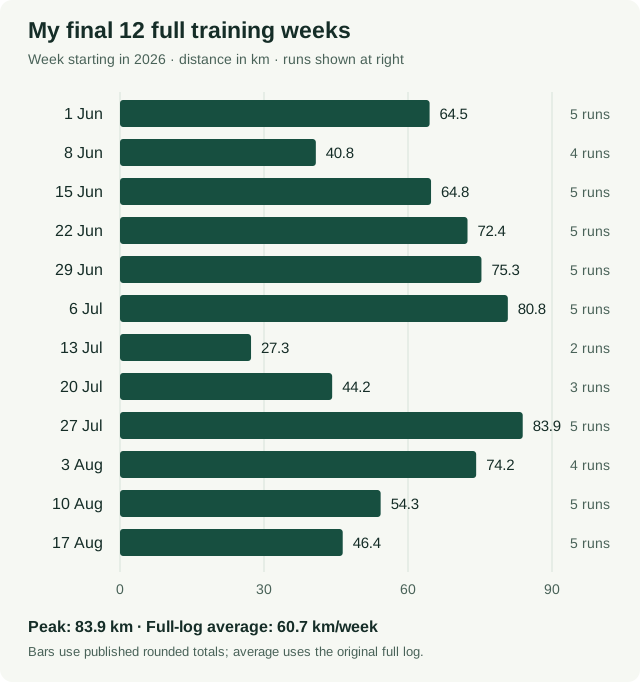
On a small screen, swipe the table if needed.
| Week starting (2026) | Running distance | Runs |
|---|---|---|
| 1 June | 64.5 km | 5 |
| 8 June | 40.8 km | 4 |
| 15 June | 64.8 km | 5 |
| 22 June | 72.4 km | 5 |
| 29 June | 75.3 km | 5 |
| 6 July | 80.8 km | 5 |
| 13 July | 27.3 km | 2 |
| 20 July | 44.2 km | 3 |
| 27 July | 83.9 km | 5 |
| 3 August | 74.2 km | 4 |
| 10 August | 54.3 km | 5 |
| 17 August | 46.4 km | 5 |
The larger dips in my running history usually came from mild injuries. That context matters: I was trying to build fitness while managing interruptions, rather than deliberately alternating very high and very low mileage. It also makes staying healthy and stringing together repeatable weeks an important part of my next build. The guide to adjusting a disrupted marathon plan covers how to reassess a build after interruptions.
The final three full weeks were 74.2, 54.3 and 46.4 km. I then ran another 20.5 km during race week before the marathon. These figures include the taper; they are a description of what I did, not a mileage prescription for another runner.
My practical change: plan from the training I can repeat, including low and zero weeks, rather than treating my best week as my normal load. The monthly planner includes all four entered weeks in its average.
A workout label did not make the effort marathon-specific
My July half-marathon pace was about 5:16/km. A 28 July workout labelled “3 × 3 km MP” had blocks at approximately 4:43, 4:50 and 4:57/km, with long recoveries. A 5 August run included 10 km labelled marathon pace at about 5:15/km.
Those sessions showed an ability to do faster work. They did not prove I could hold that pace for 42.195 km. In the latter session, the designated marathon pace was essentially my recent half-marathon race pace.
My practical change: record the intended effort, actual pace, recovery time and next-day response. A controlled marathon-pace rehearsal should be judged in the context of the whole training block, rather than counted as successful because I finished the repetitions. See tempo, threshold and marathon pace.
It became difficult before I started walking
The race started feeling difficult a little before 30 km. I first walked at roughly 31–32 km. Earlier, I had a mild stitch that I could manage with controlled breathing; when the bigger slowdown came, I was not sore. The best description of the feeling was empty.
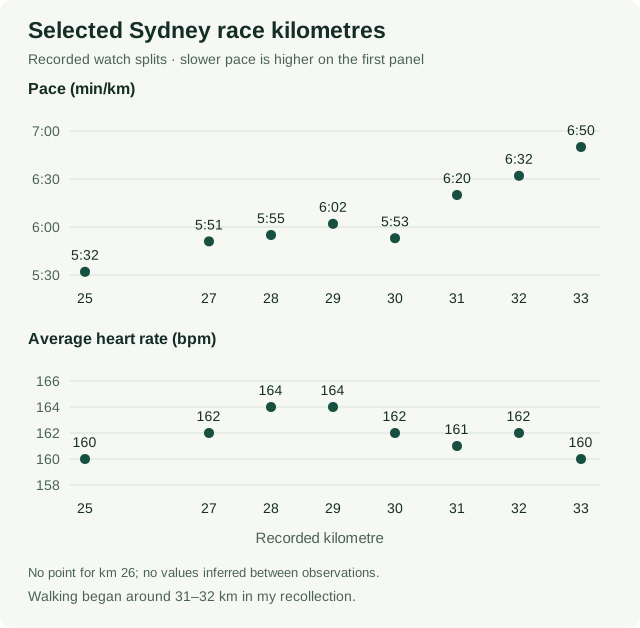
The kilometre splits in my Strava screenshots show how that change developed:
| Kilometre | Pace | Average heart rate |
|---|---|---|
| 25 | 5:32/km | 160 bpm |
| 27 | 5:51/km | 162 bpm |
| 28 | 5:55/km | 164 bpm |
| 29 | 6:02/km | 164 bpm |
| 30 | 5:53/km | 162 bpm |
| 31 | 6:20/km | 161 bpm |
| 32 | 6:32/km | 162 bpm |
| 33 | 6:50/km | 160 bpm |
Running Lab · selected recorded laps
Explore the Sydney watch splits
Inspect eight published kilometre observations and compare them with a pace you choose. Kilometre 26 is missing. These are rounded watch laps, not official course checkpoints or a complete race replay.
The recorded chart and table above remain available without the interactive controls.
Source and limits: Download the published chart data (JSON). Differences use rounded one-kilometre lap paces. A local block starts again after a missing observation; it never reconstructs elapsed time from the start. Heart rate alone does not identify why pace changed. Read the source notes or plan a separate pacing scenario.
My pace had eased before the first walking break. Once walking started, it became repeated running and walking through the later kilometres. I could still accelerate near the finish, but I had not sustained the effort I wanted over the distance.
I experienced a physical sense of depletion, and I think there may have been a psychological element too. The useful lesson for me is to recognise that change earlier and practise how I respond, rather than reduce the whole race to a question of willpower.
Taking more gels became difficult when I started to fade
I used Winners gels at Sydney, aiming to take one roughly every 20 minutes. Around the same time the race became difficult, my stomach no longer felt like taking more. That made the later part of the race harder to manage: I felt empty, but eating another gel was becoming unappealing.
For me, the lesson is that a planned schedule has to be something I can actually follow late in a long run. My earlier experiments with homemade gels had also been difficult to take, with a dry mouth. Next time I want to rehearse the products, timing and drinks together, including how they feel after several hours.
My practical change: check the carbohydrate amount on the exact product, record what I actually consume and include carbohydrate from drinks. The fueling calculator compares a selected schedule with an hourly target; I still need to practise that schedule. The timing of my symptoms is part of my experience, not proof that a particular carbohydrate shortfall caused the slowdown.
My separate account of homemade and commercial gel experiments explains the earlier dry-mouth experience, the August rehearsal and why a planned interval is not a measured race intake.
The 32 km rehearsal was another lesson in finishing well
My 9 August long run covered 32.0 km. The recorded two-kilometre laps show the first 10 km at roughly 5:16–5:31/km. By the final two full laps, the pace had eased to about 6:28/km and 6:47/km.
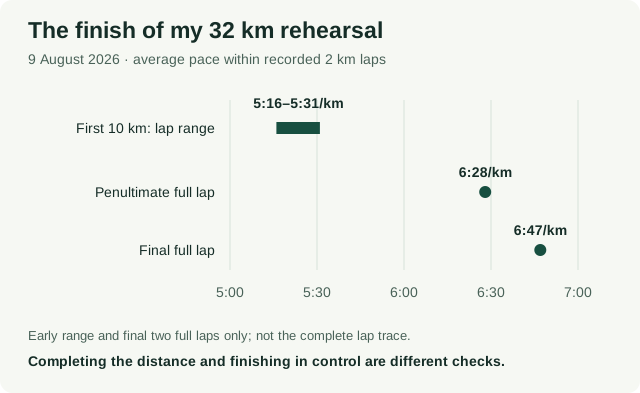
Completing the distance gave me useful experience, but the way I finished mattered too. For my next build, I want to judge a rehearsal by how controlled it feels through the later kilometres and whether I can keep taking fuel, not just by reaching the planned distance.
The figures here are average pace for each recorded two-kilometre lap, rounded to the nearest second.
What the review suggests—and what it cannot prove
My working interpretation is that I need better sustained preparation and a more manageable race-day plan, not simply more speed. The interrupted weeks, very fast work labelled marathon pace, fading rehearsal and difficulty taking gels give me specific things to revisit.
They do not establish which factor mattered most at Sydney. I cannot infer a physiological threshold from watch zones, diagnose underfueling from feeling empty or calculate a better outcome by simply removing walking breaks. A late acceleration also does not prove that the preceding fatigue was only psychological.
I want to treat these observations as questions for the next build: can I repeat the training, keep rehearsals controlled and continue taking fuel late? Those questions are more useful than claiming that one change would definitely have produced sub-four.
What I am taking into the next build
- Use consistent mileage as the baseline, rather than my best week.
- Keep marathon rehearsals distinct from faster threshold or half-marathon work.
- Choose a goal supported by recent racing, repeatable training and long-run recovery.
- Practise fueling and course-specific effort without assuming a perfect race day.
- Check effort at course markers and revise the target when it no longer fits.
My post-Sydney rebuild article sets out the intended sequence and the practical checks I want to use. It is a plan, not a claim that I have already completed the rebuild.
For the hill-specific part of a race plan, the guide to pacing climbs and descents without overloading your quads provides practical cues.
These are lessons from one runner's experience. They do not prescribe another runner's ideal mileage or explain every late-marathon slowdown.
About the training figures
This review combines my Strava export, recorded activity laps, race screenshots and personal recollections. Weekly totals use the export's metre-resolution distances and Australian local dates, grouped Monday to Sunday. All 12 weeks are included in the average; race week is shown separately. Figures are rounded after calculation. The selected race splits are transcribed from my Strava kilometre table.
My July half-marathon result and the intended workout labels come from my personal training review dated 5 September 2026. That document used an earlier training cut-off; the 12-week average above uses the later complete export and its stated dates. This is my experience of one training build and race; the calculator methods explain the separate assumptions behind predictions and plans.
The half-marathon finish behind the prediction
My 2025 and 2026 Run Melbourne comparison shows why the 2026 half gave me confidence: I finished strongly, with final full recorded kilometres of 4:53 and 4:51. Sydney was a reminder that a strong half still leaves the demands of the full marathon to prepare for.